

Study objectives
The burden of cardiovascular disease in Switzerland
Cardiovascular diseases, such as heart attack and stroke, are the leading cause of death in Switzerland, ahead of cancer.
Cardiovascular diseases are responsible for more than 20 000 deaths each year (source: Federal Statistics Office). They are also a major cause of hospitalization and disability, with a substantial impact on quality of life and healthcare costs in Switzerland.
In most cases, these events result from a progressive process called atherosclerosis. Atherosclerosis is the gradual build-up of deposits, known as plaques, within the walls of the arteries. This process often begins silently, without symptoms, and can progress for many years before becoming clinically apparent.
From around the age of 50, the risk of developing cardiovascular disease increases, including among people who have no symptoms and appear to be in good health.
Limitations of current tools for prevention
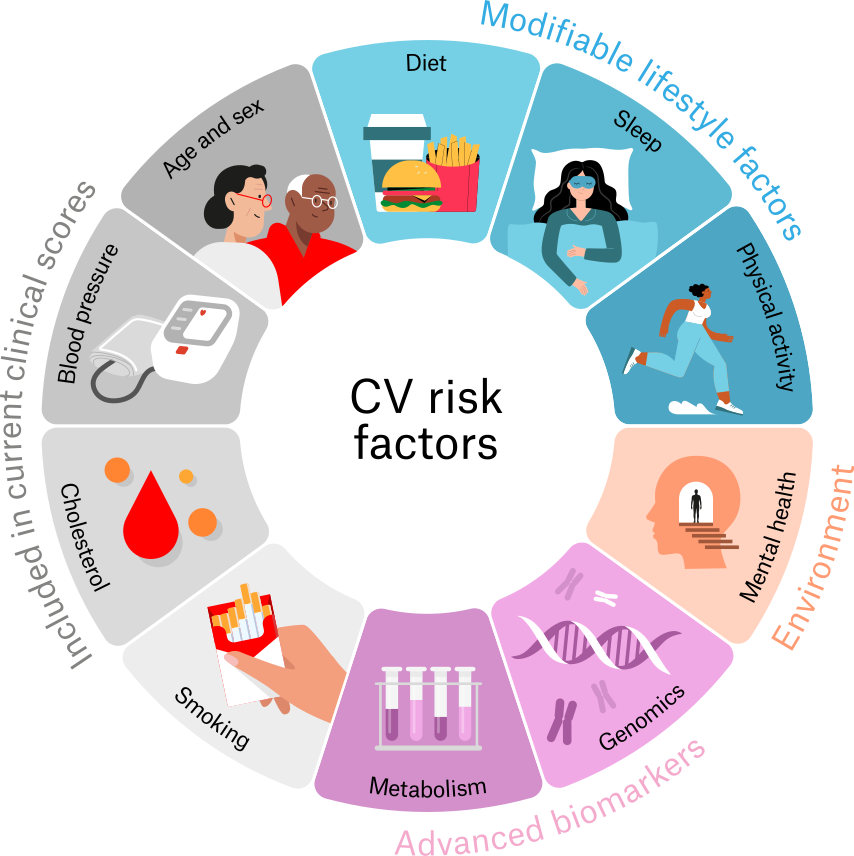
Today, cardiovascular risk assessment relies mainly on clinical risk scores based on a limited number of factors, such as age, sex, blood pressure, cholesterol levels, and smoking.
These tools are useful for guiding prevention strategies at the population level. While they can identify people at very high risk, for whom preventive treatment is indicated, many cardiovascular events actually occur in individuals classified as being at low or moderate risk.
Current tools therefore do not always provide a sufficiently precise assessment of individual risk, in particular because they cannot fully capture the complexity and diversity of the factors that contribute to cardiovascular disease.
Lifestyle factors such as physical activity, diet, and sleep are recognised as important determinants of cardiovascular health, but they are not systematically and objectively incorporated into current risk assessment.
What is the purpose of this study?
SwissCardIA aims to better characterize cardiovascular risk profiles by integrating complementary information that is still not routinely used in clinical practice, including objective lifestyle data collected using wearable devices.
A central component of the study is the non-invasive imaging of the coronary arteries using coronary computed tomography angiography (CCTA). This examination makes it possible to directly visualize deposits within the arteries of the heart, including at an early stage and in the absence of symptoms, and thereby to study subclinical atherosclerosis, well before the development of adverse events such as myocardial infarction (heart attack) or stroke.
Indeed, the presence of plaques does not necessarily mean that a cardiovascular event will occur. One of the key scientific questions is to better understand which profiles are associated with stable plaques and which are associated with a higher risk of cardiovascular events.
By combining CCTA imaging data with clinical and biological information, as well as objective measures of lifestyle, the study aims to better understand how these different factors interact in the development of atherosclerosis and, more broadly, in cardiovascular health.
At EPFL, advanced statistical methods and artificial intelligence approaches will be used to analyse these data in an integrated manner. By improving our understanding of the complex interactions between the different factors studied, researchers aim to develop more accurate models for cardiovascular risk prediction and, in the longer term, contribute to reducing the burden of cardiovascular disease.